In the turmoil of Tbilisi, the capital of Georgia, on an April evening in 2024, thousands of protesters gather to say no to Russian influence and demand accession to the European Union. Since March 6, 2023, the « Georgian Dream, » the ruling party since 2012, has been trying to pass a new law under the influence of oligarch Ivanishvili, closely linked to Russia. The method is crude: it is a barely disguised imitation of the 2012 Russian law on foreign agents, which allowed Vladimir Putin to further silence the opposition, particularly human rights associations.
For example, the Russian Committee Against Torture (KPP) was forced to close after being required to bear the label of a foreign agent. The law, initially aimed at identifying political associations receiving foreign funds, gradually extended to a wide range of groups: media, LGBT rights associations, anti-money laundering and anti-corruption organizations… After 13 years in force, the reality is clear: the law is an incredible tool at the Russian despot’s disposal to silence any dissent, especially as the country is now engaged in a war whose success remains elusive (without the free intervention of U.S. President Trump).
Therefore, when Tbilisi’s pro-European and Westernized population heard about this bill, they immediately mobilized, with some even trying to storm the Parliament. Although largely adopted by Parliament (76 votes for, 13 against), the law was finally withdrawn for the first time on March 9, 2023, under pressure from protesters. However, with the election of a new Prime Minister in February 2024, Irakli Kobakhidze, a new version of the law was considered, replacing the Russian-inspired term « foreign agent » with « organization serving the interests of a foreign power »—a different wording with the same meaning. Although protests resumed on April 15, the law was adopted in the first reading two days later and definitively on May 1, 2024, provoking a general brawl in the assembly and an unsuccessful veto attempt by the Franco-Georgian president Salomé Zourabichvili.
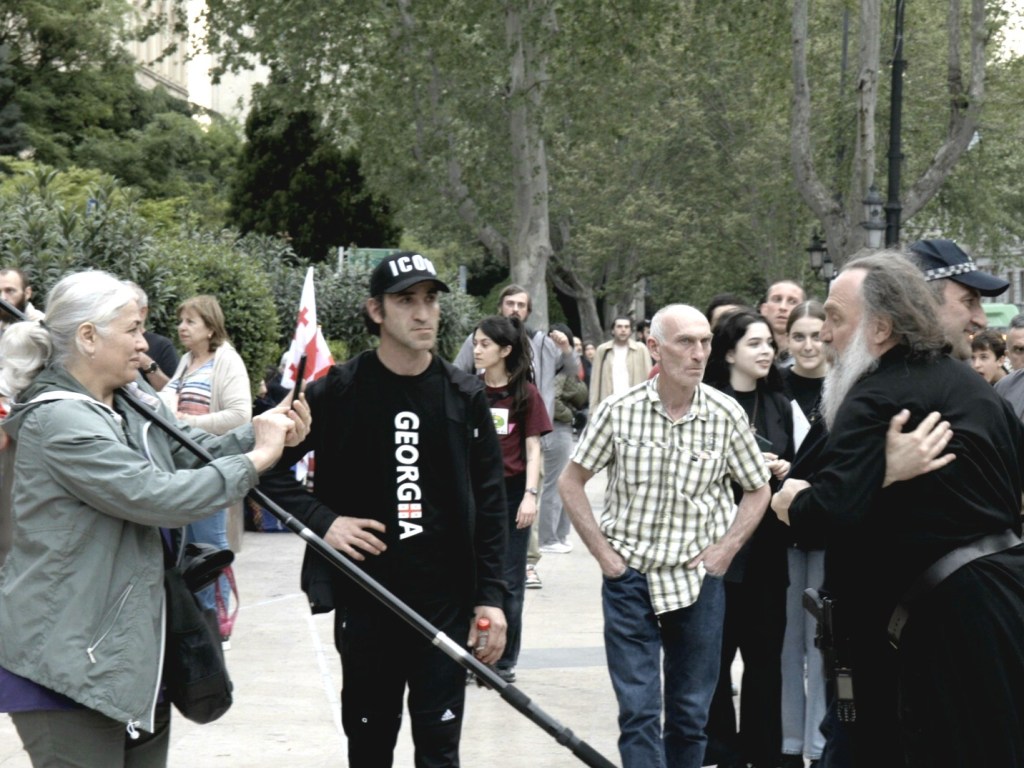
Images captured in april 2024 © Yael GOUEFFON – La Plume Libre
On-site, as protesters began to gather, one scene perfectly illustrated the tension of the situation unfolding before our eyes: an Orthodox priest, probably pro-Russian, violently confronted the protesters, first verbally, then physically, before being removed by the police. However, this would be the only act of violence that evening. As night fell, the demographics completely changed, with a very young population—young adults and sometimes children—gathering in front of the Parliament. European Union flags, NATO flags, and Ukrainian flags mingled with Georgian flags, and the youth of Tbilisi clearly seemed to favor a European and Western destiny for Georgia rather than a Russian one.
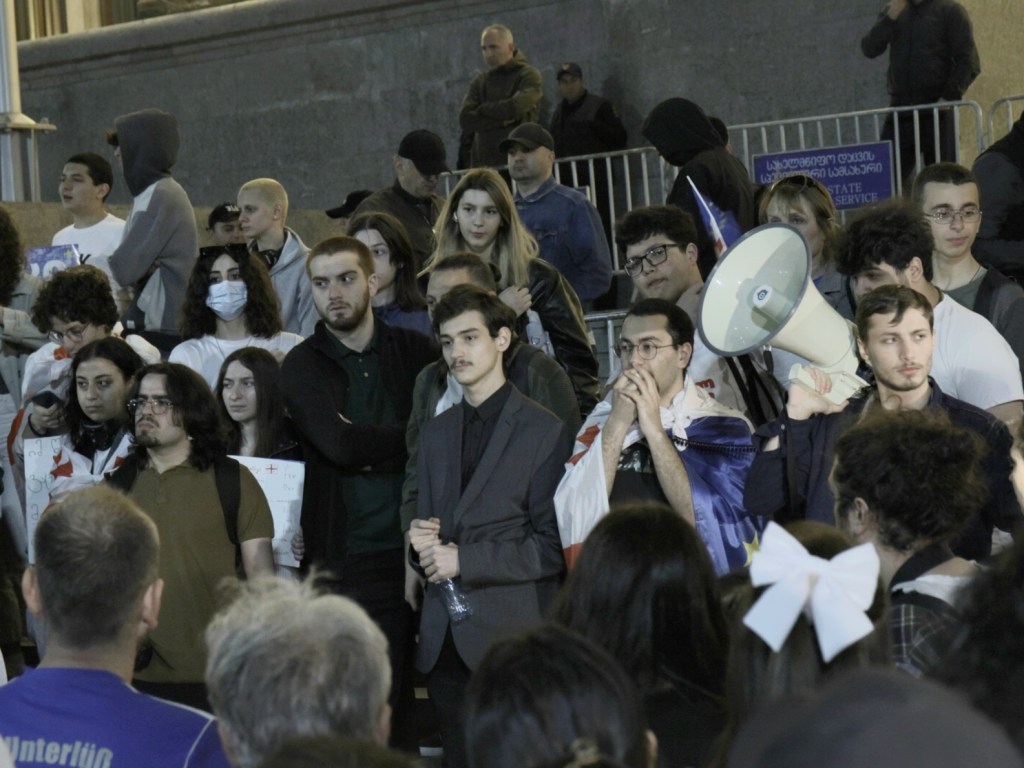
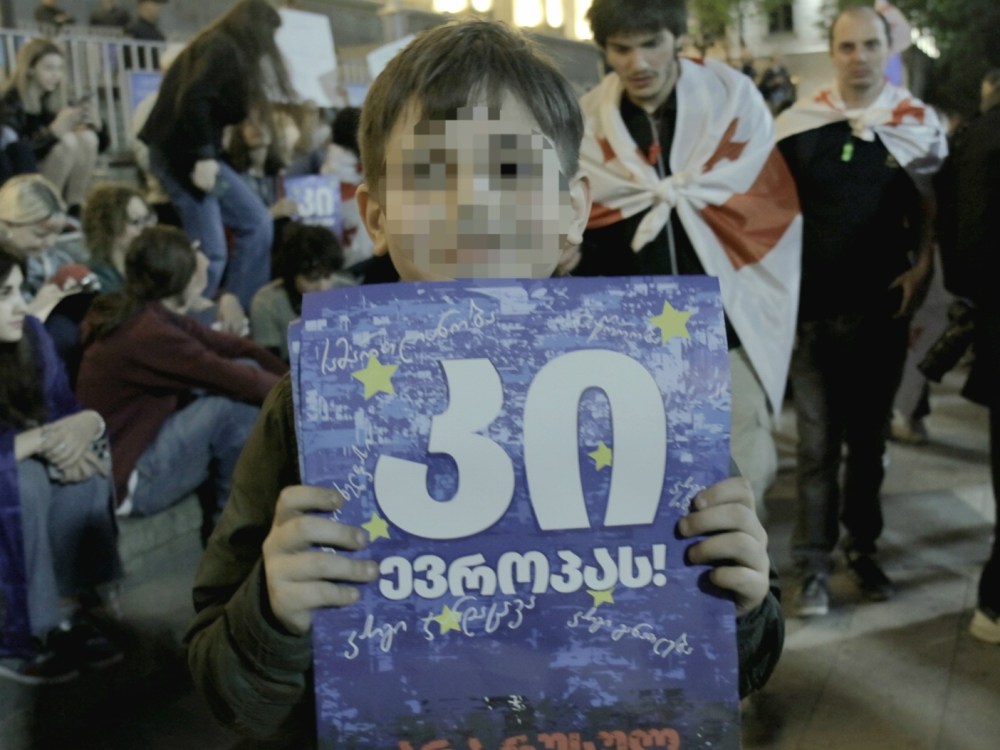
Images captured in april 2024 © Yael GOUEFFON – La Plume Libre
On October 28, 2024, new parliamentary elections saw the ruling Georgian Dream party win the majority of seats. However, President Zourabichvili, the opposition leader, declared victory and denounced electoral fraud. Indeed, numerous physical assaults and threats against voters were reported during the vote, along with irregularities in the voting system designed to favor the Georgian Dream, according to the Georgian Young Lawyers’ Association (GYLA), which advocates for democracy and human rights in the country.
That evening, new protests erupted in the capital, as well as in other major cities such as Kutaisi and Batumi, the country’s second-largest city. Since then, and with former footballer Mikheil Kavelashvili, supported by the Georgian Dream, elected as the new president of Georgia (Note: Georgia being a parliamentary regime, the president is not elected by direct suffrage but by a body of political representatives including parliamentarians), protests have continued on Rustaveli Avenue in Tbilisi as the country enters its third year of contestation against Russian influence.
Today, legislative and judicial repression against the protests is particularly alarming. On March 3, the Council of Europe, the guardian of fundamental freedoms and rights on the continent, expressed concern about laws « adopted hastily, without participation of engaged stakeholders, » creating « new severe prison sentences and a significant increase in fines for administrative offenses, [which seem] excessive. » In a press release, Amnesty International denounced penalties constituting « the instrumentalization of the criminal justice system in Georgia to stifle dissent, instill fear, and silence freedom of speech. »
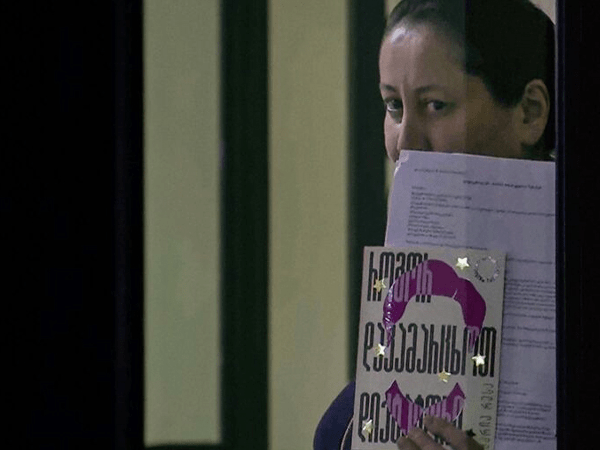
Journalist Mzia Amaglobeli during pre-prosecution © Image: Batumelebi.ge via X
One case particularly illustrates the repression orchestrated by the ruling party against pro-European protesters: that of journalist Mzia Amaglobeli, arrested on January 12, 2025, for, according to the House of Journalists, placing a strike sticker on the Batumi police station. Fourteen countries, including France, are demanding the journalist’s release, who was in pre-trial detention on March 4, accused of assaulting a police officer—charges she denies. According to her lawyer, the court « deliberately ignored 17 witnesses, 18 videos, and 14 written pieces of evidence. » The journalist and activist had also begun a long hunger strike shortly before her trial, like other imprisoned activists. Temur Katamadze, a Turk of Georgian origin, went on hunger strike for 48 days before ending up in the hospital.
On the 101st consecutive day of protests in Tbilisi, the activists do not seem willing to give up their destiny so easily, especially as the threat of a full Russian invasion—Russia already occupying South Ossetia—could become imminent if an armistice is reached in Ukraine. Thus, the Georgians are paving the way for other countries threatened by the imperialism of Russian President Vladimir Putin and his numerous influence networks across Europe.
Sources: Radio Free Europe, Human Rights Watch, BBC, Publika.ge, Batumelebi.ge, Le Monde, France Info.
Automatic translation via IA.
 La Plume Libre
Un commentaire Ajouter un commentaire